Why your gums feel sore after 50, and it's not how you brush

Your gums have started to feel tender after brushing, and nobody warned you that this would happen. Maybe it's a dull ache along the gumline in the morning. Maybe it's that one spot on the lower left that stings when the bristles touch it. Maybe you've started brushing more carefully, or less often, and you feel a little guilty about both.
If this sounds familiar
- You press a finger against your gums after brushing because they feel raw.
- Crunchy food, like a crust of bread or an apple, leaves your gums sore for an hour.
- You switched to a "sensitive" toothpaste and it helped a little, then stopped helping.
- At your last cleaning, the hygienist said "a bit of recession here" and moved on.
- You bought a softer toothbrush, then a softer one, and the sore spots are still there.
- Some mornings you brush faster than you should, just to get it over with.
If you nodded at two or three of those, you are in good company. Sore, tender gums are one of the most common complaints women mention after 50, and most of them think they are doing something wrong. Usually they are not.
Why this happens more after 50
Three things come together around this age, and none of them is your fault.
Hormones change the gums. Gum tissue responds to estrogen. When estrogen drops during and after menopause, many women notice that their gums feel thinner, drier and more easily irritated. Dentists have a name for it, and it is common enough that it shows up in dental textbooks.
The gumline moves. Over decades, gums slowly pull back from the teeth. The part of the tooth that gets uncovered, the root, has no enamel on it. It is softer and more sensitive, and the gum edge next to it is easy to irritate. This is why a brush that felt fine at 35 can feel harsh at 60.
Decades of scrubbing add up. Most of us learned to brush hard, back and forth, with a brush that was a little too stiff. Forty years of that leaves its mark. Add an electric brush that buzzes at the same spot twice a day, and tender gums are not surprising.
The usual advice is "brush gently." That is true, but it is not much help when the tool in your hand was designed for scrubbing.
What most people try, and why it disappoints
- A softer plastic brush. Better than a hard one, but nylon bristles stay stiff at the tips, and they flare and fray after a few weeks. Frayed nylon is what scrapes the gumline.
- Sensitive toothpaste. It can calm the teeth a little. It does nothing about the bristles rubbing the gums.
- Brushing less. Understandable, and the opposite of what tender gums need. Plaque builds up along the gumline, and the gums get more irritated, not less.
- Mouthwash. It can sting raw gums, and most of them are mostly alcohol and flavoring. They do not clean anything off the teeth.
- An electric brush. Some people love them. Many women tell us the vibration on an already sore gumline is the thing that made them look for something else.
So what can you do?
Start with the tool, because the tool is what touches your gums two hundred times a day.
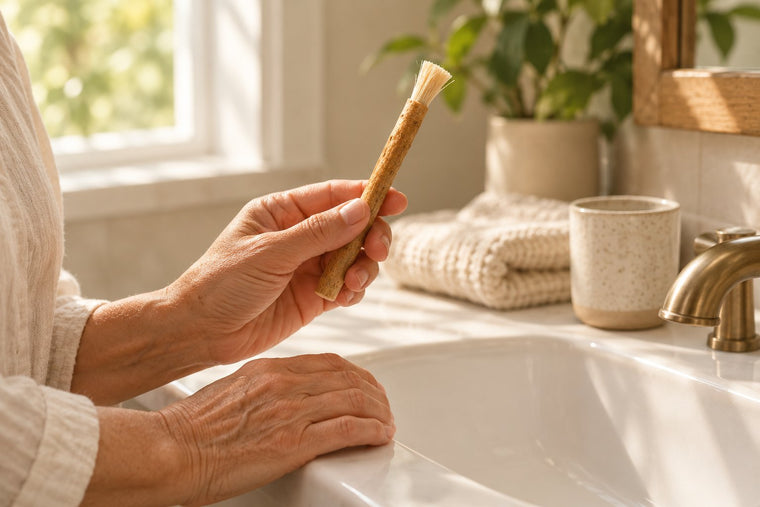
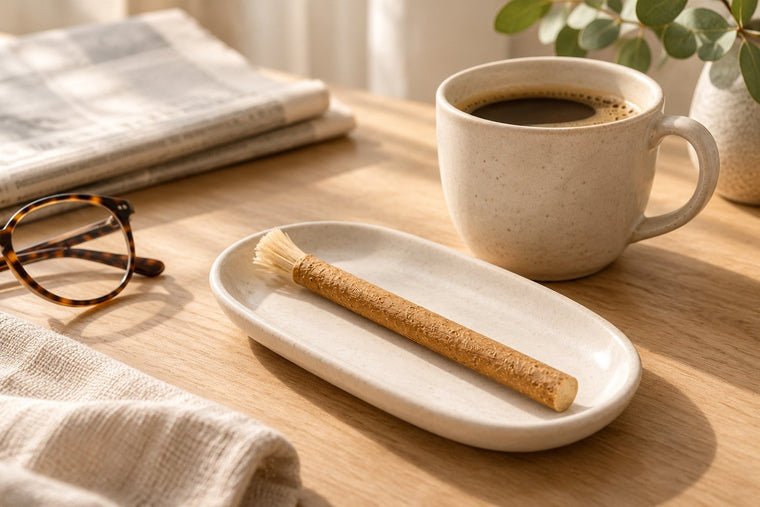
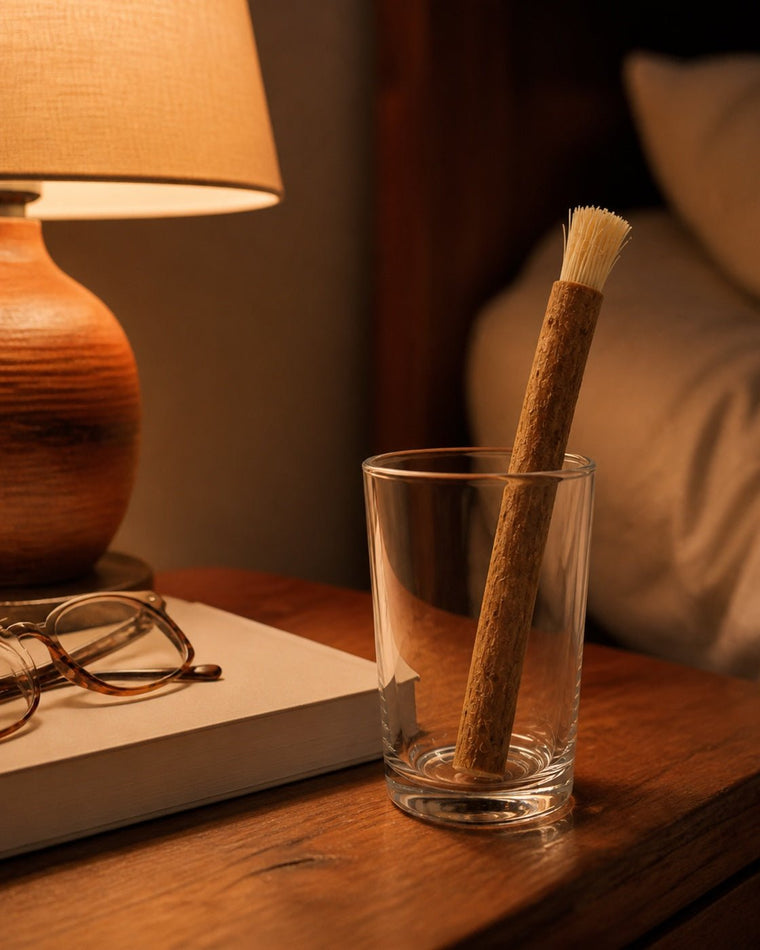
A miswak is a cleaning stick cut from the root of a small tree called Salvadora persica. People have cleaned their teeth with it for about 7,000 years, in dozens of countries, long before anyone glued nylon into a plastic handle. You peel about half an inch of bark from one end, chew the tip gently for a moment, and the wood separates into fine, soft fibers. Those fibers are the brush.
Here is why that matters for sore gums:
The fibers are soft and natural. They are not cut to a sharp tip like nylon. They bend. When you hold the stick upright and move it up and down, away from the gumline, the fibers reach the edge of the gum without scraping it the way worn bristles do.
You get a fresh tip every day or two. With a plastic brush, you use the same fraying bristles for months. With a miswak, you trim off the used end and chew a new one. You are never brushing with worn, splayed bristles.
It works with or without toothpaste. If your dentist wants you on a fluoride toothpaste, keep using it. If the foam and the flavoring bother your gums, you can brush with the stick alone.
Chewing gets saliva going. The chewing you do to prepare the tip has a side effect: your mouth makes more saliva. Saliva is the mouth's own rinse, and gums that are often dry tend to be gums that are often sore.
There is a body of published research on Salvadora persica. We link the studies on our research page so you can read them yourself. Results vary, and a miswak is not a treatment. Think of it as a gentler way to do the same daily job.

What it's honestly like
It is a stick. It looks like a twig, because it is one. It is about the thickness of a pencil and about as long as your hand. The first two or three days feel odd, mostly because you are used to a handle and a head. By the end of the first week most people stop noticing. One stick lasts two to three weeks, then you open the next one. It is not a medicine, and it will not fix gums that need a dentist. If your gums bleed regularly or hurt, please get them looked at. A miswak is for the everyday part, the two minutes in the morning and the two minutes at night, done more gently.
This article is general information, not medical advice. A miswak is a cleaning tool, not a treatment. If your gums bleed regularly, hurt, or if a problem does not go away, please see your dentist.