Cold water shouldn't hurt

A sip of cold water hits one tooth like a small electric shock, and for a second you lose track of what you were saying. You have learned to drink around it. Ice cream on the other side of the mouth. Tea only once it has cooled. A sharp breath through the teeth on a winter walk, and there it is again.
If this sounds familiar
- You let cold drinks sit on the counter for a minute before you take a sip.
- You chew on one side of your mouth without thinking about it.
- Brushing certain spots near the gum makes you flinch.
- You tried a sensitive toothpaste, it helped a little, then you went back to your usual tube and the zing came back.
- Your teeth look a bit longer at the gumline than they used to.
- At the last checkup the dentist said "some wear here" and "a little recession," and you nodded and forgot.
If you nodded at a few of those, you are in good company. Sensitive teeth are one of the most common complaints after 50, and most people think they have simply been unlucky. Usually there is a plainer reason.
Why this happens more after 50
A tooth has a hard outer coat of enamel above the gumline. Below the gumline, the root is covered by a softer layer full of tiny channels that lead toward the nerve. When that softer layer is exposed, cold, heat and sometimes even air reach the nerve, and you feel it.
Two things uncover it, and both take decades.
The gums pull back. Over the years the gumline moves down the tooth, and the root surface, which was never meant to be exposed, is out in the open. This is why the teeth look longer and why the sensitive spot is almost always right at the gum.
The enamel wears thin. Forty years of brushing hard, sideways, with a brush that was a little too stiff, slowly scrubs the enamel near the gumline thinner. Whitening toothpastes, which clean by scouring, speed that up. Acidic drinks, like wine, citrus and soda, soften the surface so the next brushing takes more off. Grinding at night adds its share.
Add menopause, which thins the gum tissue, and the dry mouth that comes with many medicines, and the gumline is more exposed and more easily worn than at 40. None of that is your fault.
What most people try, and why it disappoints
- Sensitive toothpaste. It can help. For many people it helps only partly, and only while they keep using it. It does nothing about the scrubbing that uncovered the spot.
- Whitening toothpaste. The grit that makes it work is the same grit that wears the thin spots thinner. For sensitive teeth it is going the wrong way.
- Brushing harder on the sore spots. It feels like cleaning. It is the same motion that caused the trouble.
- Mouthwash. Many contain alcohol, which stings an exposed root, and rinsing does nothing for the wear.
- An electric brush. Some people do well. Others press it hard against the same sore spot twice a day.
So what can you do?
The first thing is to quit scouring. Nothing you brush with should grind the gumline, and the motion should run along the tooth instead of across it. That is hard to do with a stiff brush and a gritty paste.
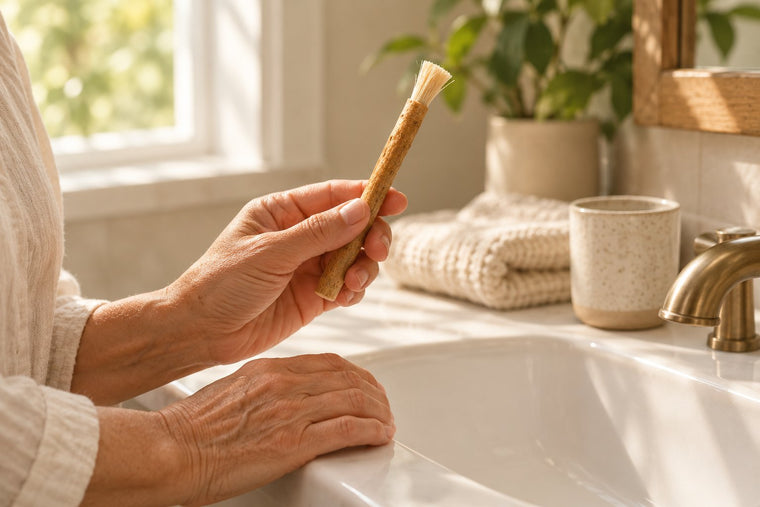
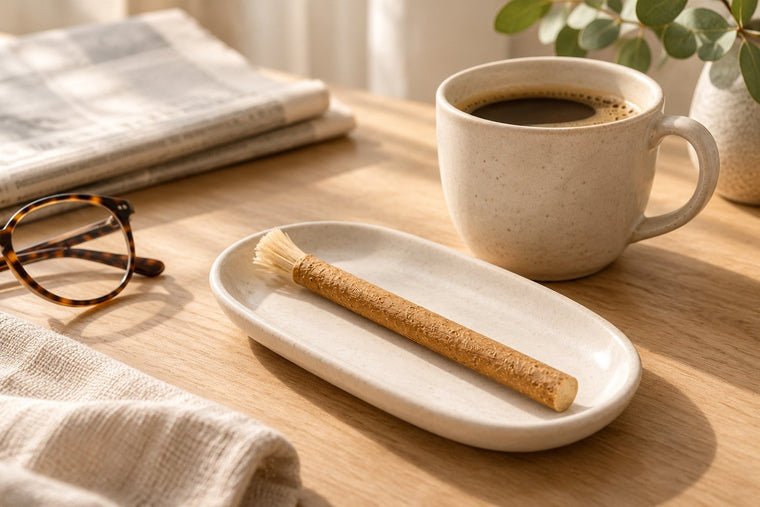
A miswak is a cleaning stick cut from the root of a small tree called Salvadora persica. People have cleaned their teeth with it for about 7,000 years, in many countries. You peel about half an inch of bark from one end, chew the tip gently until the wood separates into soft fibers, and brush for about two minutes with the stick upright, moving it up and down, away from the gum.
Here is why that fits sensitive teeth in particular:
Nothing gritty. The stick cleans with soft wood fibers, and there is no scouring paste on them unless you put one there. If your dentist wants you on a fluoride or sensitive toothpaste, keep it. A little on the fibers works fine.
Soft fibers that bend. Nylon bristles stay stiff at the tips and fray, and frayed tips dig at an exposed root. The natural fibers are soft and a little uneven, and they bend along the gumline instead of scraping it. You trim the tip every day or two, so you never brush with worn bristles.
The right motion becomes the easy one. Held upright, the stick wants to go up and down along the tooth. Scrubbing sideways with it is awkward, which is the habit you are trying to lose.
There is a body of published research on Salvadora persica. We link the studies on our research page so you can read them yourself. Results vary, and a miswak is not a treatment.

To be plain about what the stick does and does not do: it will not rebuild enamel, and it will not cover a root that the gum has left exposed. What it changes is the scrubbing, which keeps making the thin spots thinner. If one tooth hurts sharply, if the pain lingers after the cold is gone, or if it wakes you at night, that can be a crack or a cavity. Please see your dentist for that.
What it's honestly like
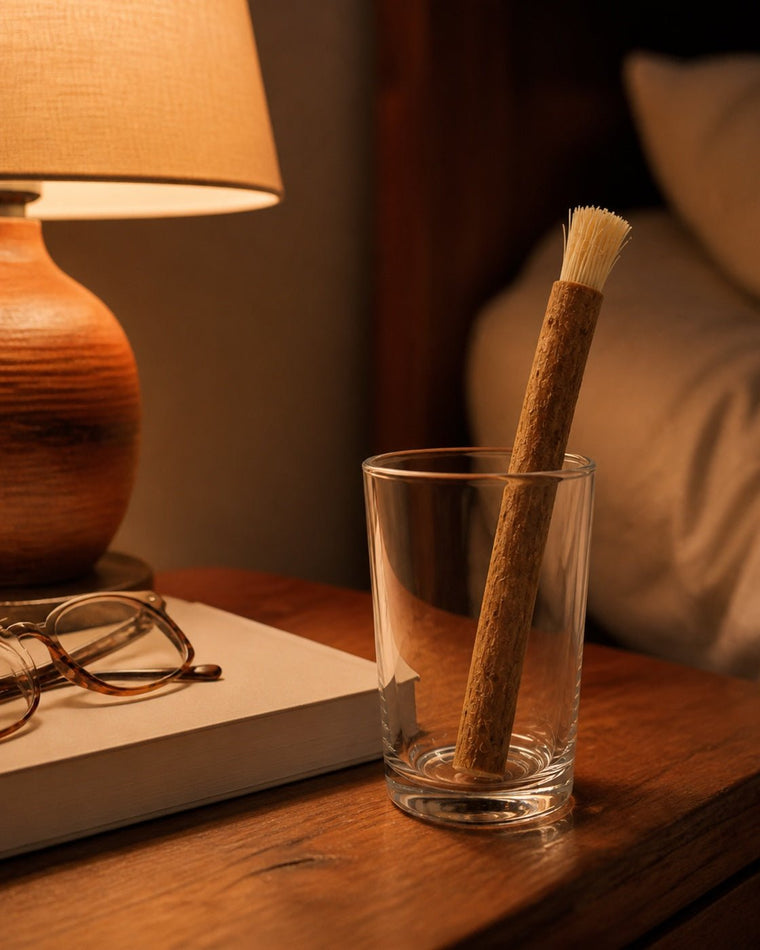
It is a stick. It looks like a twig because it is one, about as thick as a pencil and four to six inches long. The first few days feel odd, mostly because there is no handle and no foam. By the end of the first week most people have stopped noticing. You trim the tip every day or two and open a new stick every two to three weeks. It is not a medicine, and it will not fix a tooth that needs a filling. It is a gentler way to do the two minutes, morning and night, without the grit and the scrubbing that got the gumline here in the first place.
This article is general information, not medical advice. A miswak is a cleaning tool, not a treatment. If your gums bleed regularly, hurt, or if a problem does not go away, please see your dentist.