One thing in your purse that replaces three things in your bathroom

Your bathroom counter has a toothbrush on a charging stand, a pack of replacement heads in the drawer, and a cord that never sits right, and all of it is there for two minutes of brushing twice a day.
If this sounds familiar
- The charging stand lives by the sink, and the cord collects toothpaste spots no matter how often you wipe it.
- There is a half-open pack of brush heads in the drawer, and you are not sure it fits the brush you have now.
- When you travel, the brush, the charger and a spare head take up a corner of the suitcase, and the charger makes it home about half the time.
- You keep an old manual brush as a spare. It has been the spare for three years.
- After lunch out, you would like to clean your teeth, and there is nothing in your purse that can do it.
- You carry a tin of mints and a pack of gum, and each one does half a job.
None of that makes you disorganized. It is what happens when every piece of the routine is sold separately.
Why it piles up
By the time you are in your fifties or sixties, you have been buying things for your teeth for forty years or more. A dentist suggested an electric brush at some point, so you bought one. The heads wear out, so you bought a pack that will outlast the brush. The charger needs an outlet, so it took the one by the sink. Somewhere along the way you added a travel brush, a travel toothpaste, and a case for the travel brush.
Each thing solved one small problem and brought its own accessories. Nobody plans a crowded counter. It happens one purchase at a time, over decades.
The other half of the problem is the afternoon. Brushing is tied to a sink and a plug, so between breakfast and bedtime your teeth are on their own. Mints fill the gap, and mints do not clean anything.
What most people try, and why it disappoints
- A travel toothbrush with a cap. It still needs a sink and a tube. The cap traps moisture, the brush stays damp, and it becomes a fourth brush in the house.
- A battery brush for the suitcase. One more battery, one more head to replace, one more thing that dies in a hotel.
- Mints and gum. They cover things for about twenty minutes and leave your teeth exactly as they were.
- Floss picks in the purse. Good for between the teeth. They do nothing for the surfaces.
- Mouthwash minis. Mostly alcohol and coloring. They sting, and they take nothing off the teeth.
- Waiting until you get home. Which is fine, until the afternoon runs long.
So what can you do?
Carry the brush with you. That only works if the brush is small, needs no plug, and needs no water.
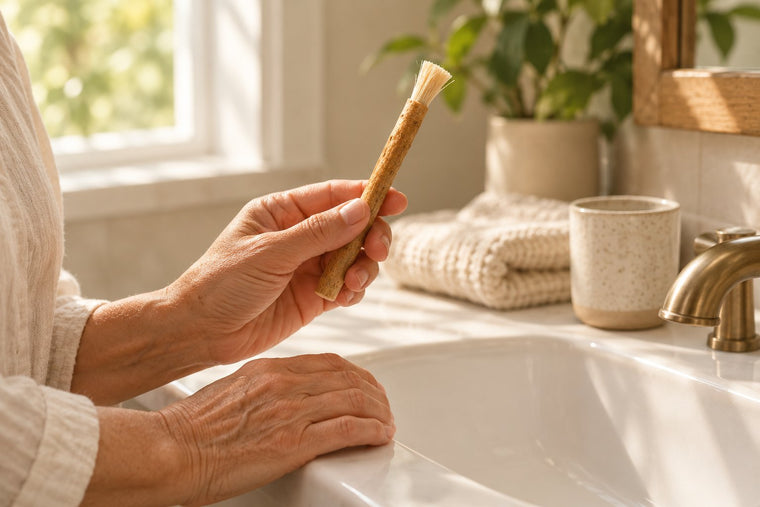
A miswak is a cleaning stick cut from the root of a small tree called Salvadora persica. People in dozens of countries have cleaned their teeth with it for around 7,000 years. You peel about half an inch of bark from one end, chew the tip gently until the wood separates into soft fibers, and brush with those fibers, stick held upright, moving up and down away from the gum. Two minutes.
Here is what that means for the counter and the purse:
One stick is the brush, the head and the battery. There is no handle to charge, no cord, no stand, no replacement heads to match, and no plastic bristles. When the fibers wear, you trim off the used end and chew a new one. After two to three weeks the stick is short, and you open the next one.
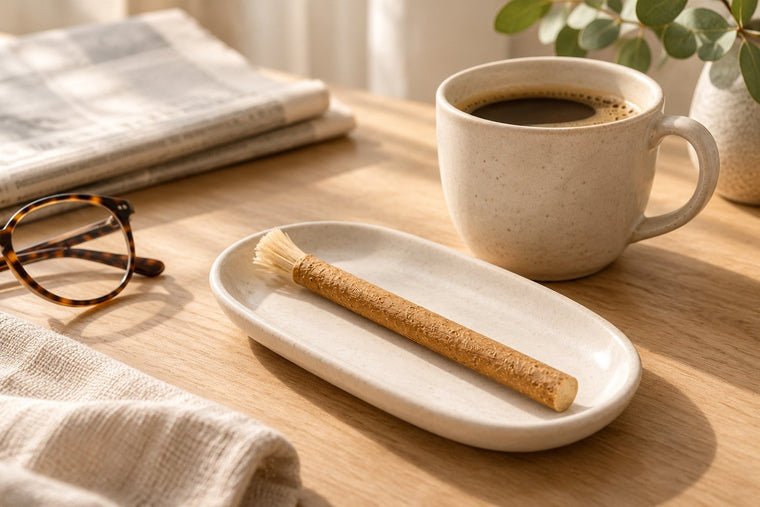
It goes where you go. In its sealed sleeve it fits in the side pocket of a purse. Once opened, keep it in a small pouch or a clean pocket, and you have a toothbrush at your desk after coffee, in the car once you have parked, in a hotel room before you have unpacked, or at the rest stop on a long drive. No sink, no tube, no outlet.
A few rules, because it is a stick. Use it sitting or standing still. Never while walking, never lying down, and never while driving. Loose fibers come off now and then, and you spit them out. Our use-and-safety page has the short version.
With or without toothpaste. If your dentist wants you on a fluoride toothpaste, keep using it at home. Away from a sink, you can brush with the stick alone.
Less on the counter, less plastic. The stick is wood. When it is used up, it goes in the compost or the trash and breaks down. The sleeve is a thin plastic film, and we say so plainly. Even so, three sticks in a drawer take the place of a handle, a charger and a pack of heads, and they leave no bristles behind.
There is a body of published research on Salvadora persica. We link the studies on our research page so you can read them yourself. Results vary, and a miswak is not a treatment.

What it's honestly like
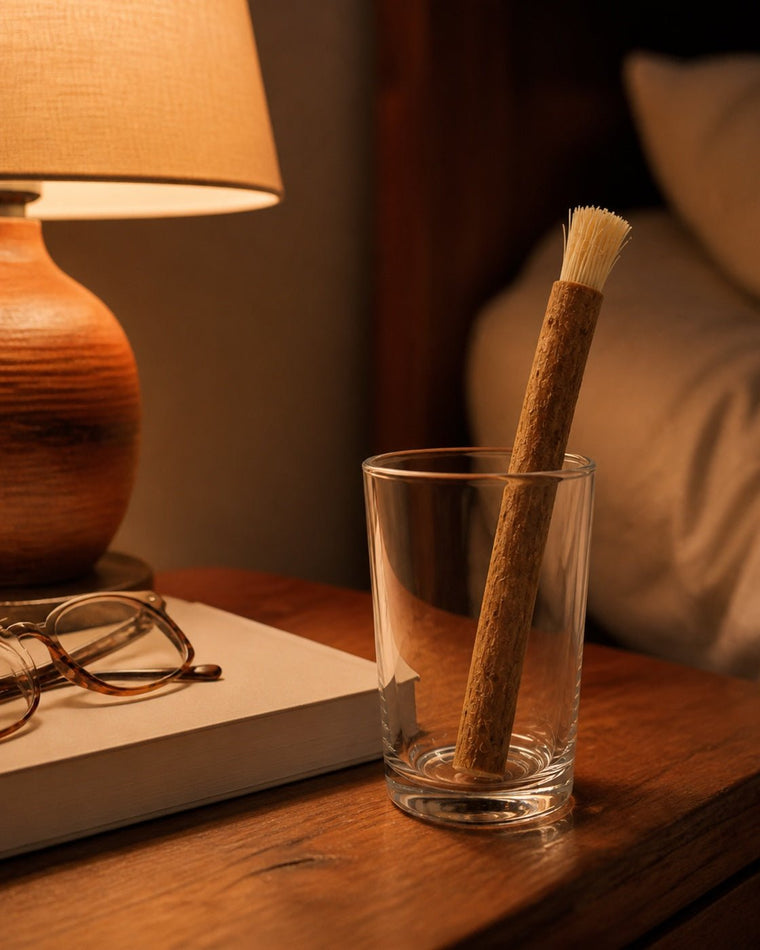
It is a stick, and it looks like a twig, because it is one. It is about as thick as a pencil and about the length of your hand, which also means it is easy to lose in a big purse. The first few days feel odd, mostly because there is no handle and your fingers keep looking for one. After a week or so the grip stops being strange. It is not a medicine, it does not replace your dentist, and it will not make your bathroom look like a magazine. It means the thing you brush with fits in your pocket, and the counter has three fewer things on it.
This article is general information, not medical advice. A miswak is a cleaning tool, not a treatment. If your gums bleed regularly, hurt, or if a problem does not go away, please see your dentist.