What's really in the tube

You have squeezed the same kind of toothpaste onto a brush for fifty years and never read the back of the tube. Most of us haven't. The print is tiny and the words sound like chemistry class. Still, that list is worth four minutes if your mouth has become more sensitive than it used to be.
If this sounds familiar
- The inside of your cheeks feels raw after brushing, and you blame the brush.
- You get a small mouth sore now and then, and nobody has ever told you why.
- You noticed a line on the tube about children and Poison Control, read it once, and decided not to think about it.
- You have no idea what half the ingredients are, and you feel a little silly asking.
If two or three of those are you, keep reading. We are not trying to scare you, just to show you what goes into your mouth twice a day.
What is on the list
Turn a normal tube over. In the US, fluoride toothpaste is sold as an over-the-counter drug, which is why the back has a "Drug Facts" box. Under "Inactive ingredients" you will usually find some version of these.
Sodium lauryl sulfate, or SLS. This makes toothpaste foam, the same way it makes shampoo foam. Foam has nothing to do with cleaning. It just feels like it. Some people find that SLS irritates the lining of the mouth, and some who get small mouth sores notice fewer of them with a paste that leaves it out. That is not true for everyone. Still, SLS-free toothpastes exist for a reason.
Dyes and sweeteners. The blue stripe, the green gel, the saccharin and sorbitol. They make the paste look and feel the way the box promises. They do nothing for your teeth.
Titanium dioxide. A white pigment, also used in paint and sunscreen. Its only job here is to make the paste white. The European Union stopped allowing it in food in 2022; the US still allows it. We are not saying it will hurt you. It is there for the color.
Abrasives. Hydrated silica, calcium carbonate. The grit that polishes. A "whitening" paste has more of it, which is hard on a gumline that has pulled back.
And then the warning. Every fluoride toothpaste sold in the US carries words like these: "Keep out of reach of children under 6 years of age. If more than used for brushing is accidentally swallowed, get medical help or contact a Poison Control Center right away."
Please read that calmly. The FDA requires it because fluoride is an active drug ingredient, and a small child who eats much of a tube can get sick. "More than used for brushing" means far more than the pea on your brush. For an adult who brushes and spits, the label is not about you. Fluoride protects against cavities, and if your dentist has told you to use fluoride toothpaste, keep using it.
Why this matters more after 50
The ingredient list has stayed much the same for decades. What changes after 50 is the mouth it goes into.
After menopause, gum tissue and the lining of the mouth get thinner and drier. Many women also take a medication that dries the mouth, for blood pressure, allergies, sleep or mood. With less saliva to rinse things away, what was mildly irritating at 35 can be plainly irritating at 60. Add a gumline that has receded, and the grit has soft root surface to scrub. None of that is your fault.
What most people try, and why it disappoints
- Switching brands. Most tubes, including many labeled "natural," have the same foaming agent and the same list in a different order.
- "Sensitive" toothpaste. It can calm the teeth. The foam and the grit are still there.
- Whitening or charcoal paste. More abrasive than regular paste, and hard on thin gums and exposed roots.
So what can you do?
Start with a simple fact: you do not need foam to clean your teeth. Cleaning happens where the bristles meet the tooth and the gumline. The foam, the color and the sweetener only make brushing feel like brushing.
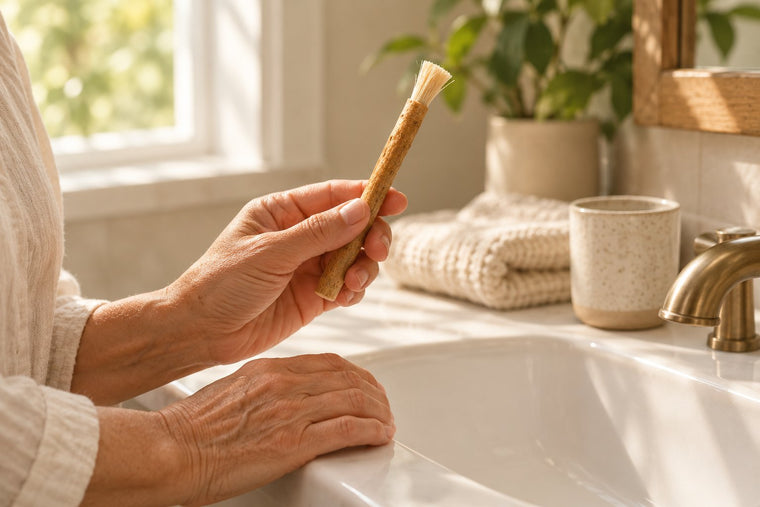
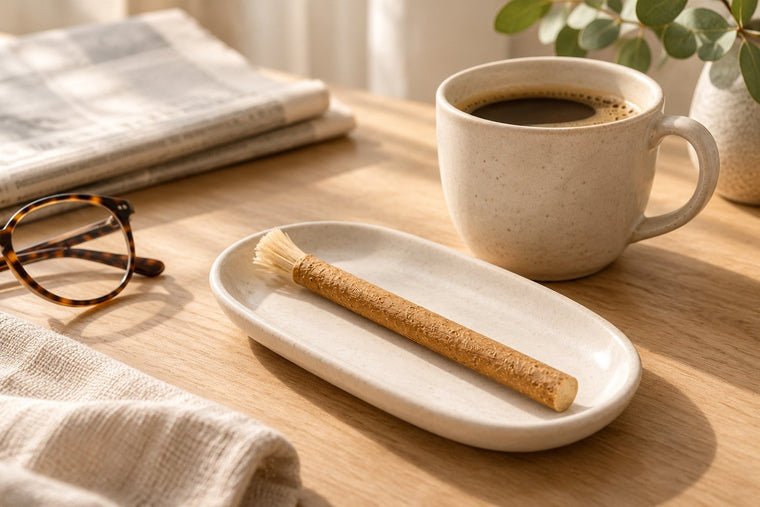
A miswak is a cleaning stick cut from the root of Salvadora persica, a small tree, used for about 7,000 years in many countries. You peel about half an inch of bark from one end, chew the tip until the wood separates into fine, soft fibers, and brush with those, upright, away from the gum, about two minutes. Every day or two you trim the used end and chew a new one. One stick lasts two to three weeks.
For this problem, that matters in four ways:
Its ingredient list is the root. No foaming agent, no dye, no sweetener, no white pigment, no grit. Our product page lists the 19 active compounds found in the wood, and that is all there is.
It works with or without toothpaste. This is the important line. If your dentist wants you on fluoride, put a pea of it on the fibers and brush as usual. You still get the fluoride, and you can pick a paste without the foaming agent and the dye. If toothpaste itself bothers your mouth, brush with the stick alone and ask your dentist where your fluoride should come from.
The fibers are soft. They are not cut to a point like nylon, and you never brush with a tip that has been fraying for three months.
Chewing gets saliva going. Opening a new tip means chewing for a moment, and chewing makes the mouth produce saliva. For a dry mouth, that helps.
There is a body of published research on Salvadora persica. We link the studies on our research page so you can read them yourself. Results vary, and a miswak is not a treatment.

What it's honestly like
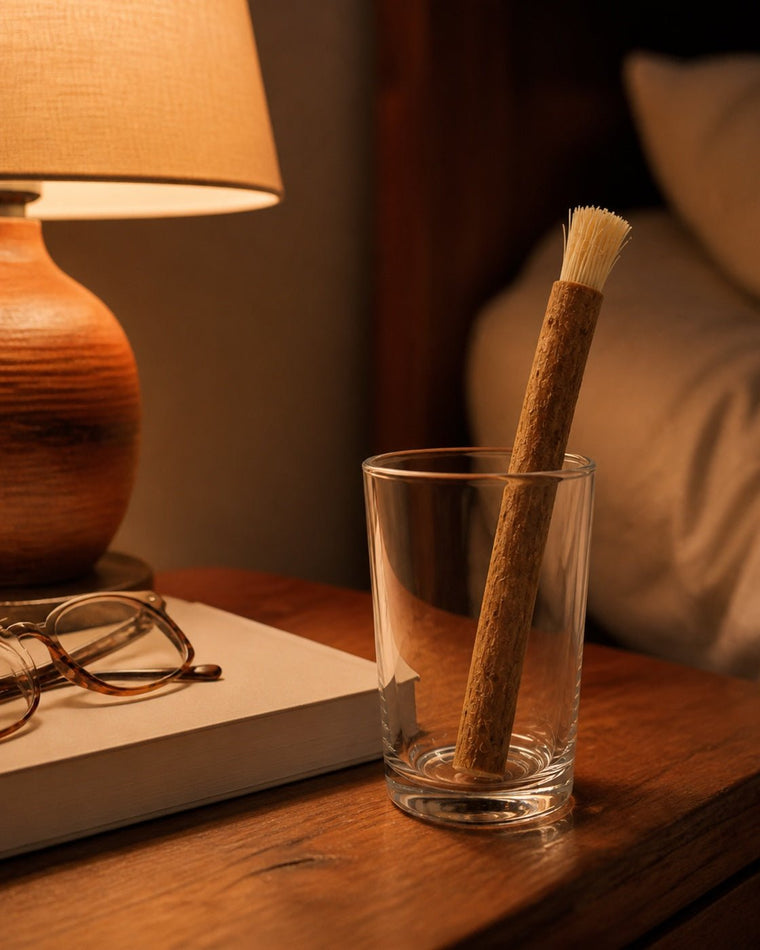
It is a stick. It looks like a twig, because it is one, about the thickness of a pencil and about as long as your hand. It comes sealed in a thin plastic sleeve to keep it from drying out. The first few days feel strange, mostly because nothing foams. After a week most people stop noticing. It is not a medicine, it does not replace fluoride if your dentist wants you on it, and it does not replace your dentist. If a mouth sore lasts more than two weeks, or your gums bleed regularly, please have it looked at.
This article is general information, not medical advice. A miswak is a cleaning tool, not a treatment. If your gums bleed regularly, hurt, or if a problem does not go away, please see your dentist.