The 7,000-year-old toothbrush

Every few years someone hands you a new way to clean your teeth, and your mouth does not feel any better for it. A brush with a motor. A water jet. Floss on a little plastic handle. Your drawer holds the last decade's good ideas, and the hygienist still says the same two sentences she said in 1995.
People cleaned their teeth for thousands of years before any of this existed, and the tool they used is still sold in markets today.
If this sounds familiar
- There is a charger on your bathroom counter that belongs to a toothbrush you no longer use.
- You have bought a "new and improved" toothbrush at least ten times and could not say what improved.
- A box of floss picks sits half used because they hurt the spaces between your back teeth.
- Your gums feel more tender now than they did with the plain brush you had as a girl.
- You are a little tired of being sold things for your mouth.
If any of that is you, this article is a short history and a small suggestion.
The chew stick
Long before brushes had handles, people cleaned their teeth with a stick: a twig or thin root from the right kind of tree, chewed at one end until the fibers separate, then rubbed along the teeth. The oldest records go back thousands of years. Across the dry parts of Africa, the Middle East and South Asia it was the usual way to clean teeth, and in many of those places it still is.
The tree most often used is Salvadora persica, sometimes called the toothbrush tree. It is small and scrubby, grows where little else does, and its roots have the right kind of fiber: soft when chewed, firm enough to clean, naturally a little uneven. The stick has different names in different languages; miswak is the one most people know. In parts of Africa, other trees do the same job.
The toothbrush as we know it, bristles set into a handle, is only a few hundred years old, and the bristles were animal hair until the first nylon toothbrush went on sale in 1938. Electric brushes came later still. The plastic toothbrush is not yet a hundred years old. The chew stick is roughly eighty times older.
Grandmothers without toothbrushes
In many countries there are women in their seventies and eighties who have never owned a plastic toothbrush. They grew up with a stick, as their mothers did. It was bought in a bundle at the market, kept in a pocket, chewed open in the morning and trimmed when the end wore out. There was nothing to plug in and nothing to throw away but a bit of wood.
We are not going to tell you those women had perfect teeth; we do not know that. What we can say is that the stick was never an oddity. For a large part of the world it was simply the toothbrush.
Why this matters more after 50
You have lived through the whole plastic era. If you were born in the 1950s or 60s, you got your first nylon brush as a child and have used one ever since. Decades of stiff tips and back-and-forth scrubbing leave their mark, and it shows up now as tenderness and a gumline that has pulled back a little.
Your gums want gentler, and the market offers stronger. After menopause, gum tissue is thinner and drier. A thin gumline wants soft contact, every day. What you are offered is more power and more modes.
Simple is easier to keep up. Something with no battery and no parts is something you will actually use twice a day, at home and away. That matters more than any feature.
What most people try, and why it disappoints
- The next brush. Better marketing, same contact with the gumline.
- The water flosser. Useful between the teeth, and it does not replace the brush. It is also one more thing to fill, charge and clean.
- Floss picks. Easy to carry. Many people find them sharp on tender gums.
So what can you do?
Try the oldest tool there is, the way it was always used.
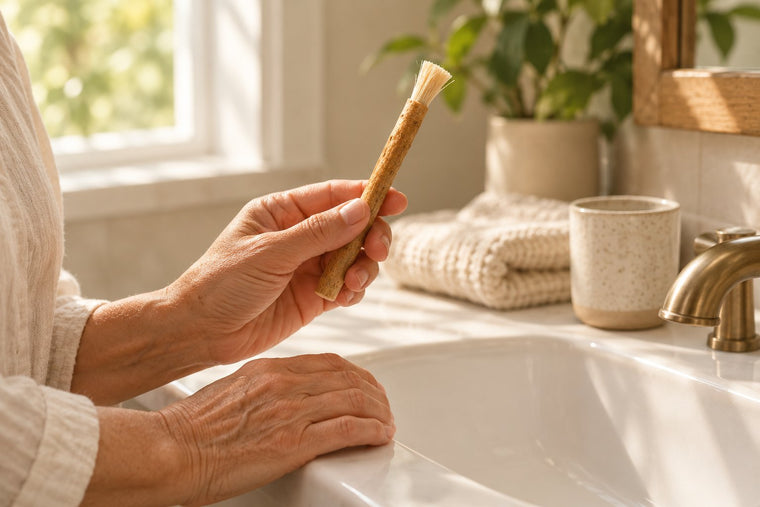
An MSWK miswak is a root stick from Salvadora persica, cut and sealed one at a time. You peel about half an inch of bark from one end, chew the tip gently until the wood separates into fine, soft fibers, and brush with those. Hold it upright, move it up and down away from the gum, about two minutes, morning and night. Every day or two you trim the used end and chew a new one. One stick lasts two to three weeks.
Why it fits the person who is tired of gadgets:
It is one thing. One stick replaces brush, head and battery. No charger, no cord, no heads to reorder, no app.
It leaves almost nothing behind. The stick is wood and goes in the compost. The only plastic is the thin sleeve it comes sealed in to keep it from drying out.
The fibers are soft and natural. Slightly uneven, as wood is, and never cut to a point like nylon. You chew a new tip every day or two, so you never brush with a worn one.
It works with or without toothpaste. If your dentist has told you to use fluoride, keep using it on the fibers.
Chewing gets saliva going. Opening the tip means chewing, and chewing makes the mouth produce saliva. For a dry mouth, that is a welcome side effect.
There is a body of published research on Salvadora persica. We link the studies on our research page so you can read them yourself. Results vary, and a miswak is not a treatment.

What it's honestly like
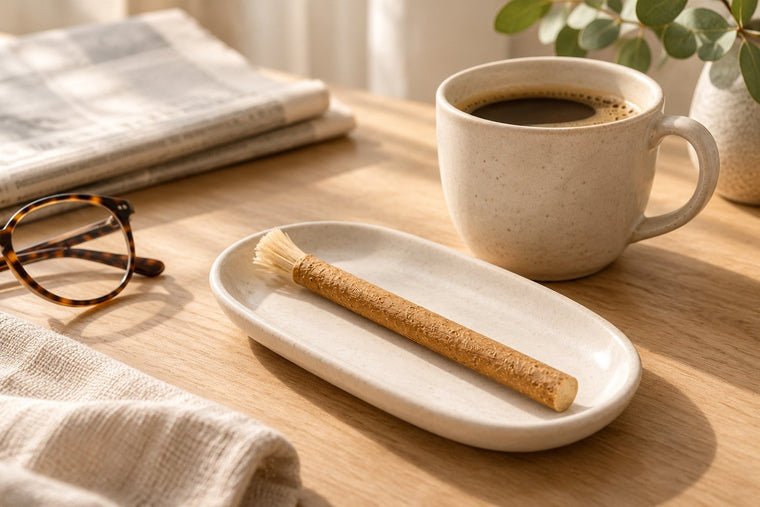
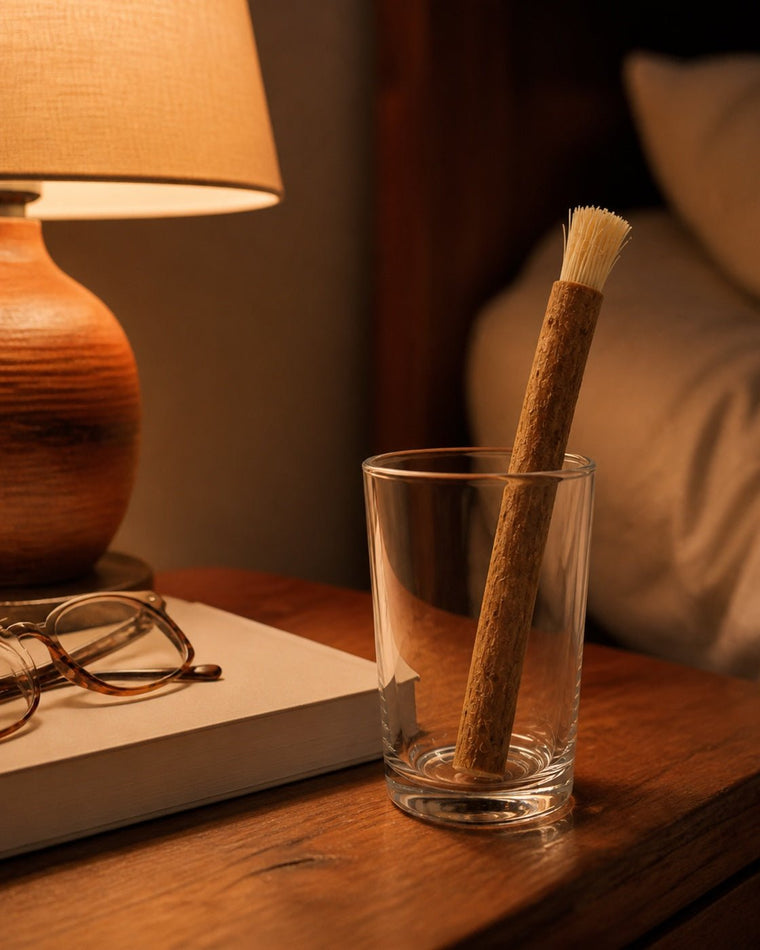
It is a stick. It looks like a twig, because it is one, about the thickness of a pencil and about as long as your hand. The first few days feel strange, because sixty years of handles and foam are a hard habit to set down. By the end of the first week most people stop noticing. It is not a medicine, it is not a piece of history to admire on a shelf, and it does not replace your dentist. If your gums bleed regularly, hurt, or a problem does not go away, please have it looked at. It is simply the oldest way of doing a two-minute job, done gently.
This article is general information, not medical advice. A miswak is a cleaning tool, not a treatment. If your gums bleed regularly, hurt, or if a problem does not go away, please see your dentist.